











.jpg)


How software is redefining the vehicle
The automotive industry is undergoing the biggest transformation since the introduction of electronics in vehicles: future vehicles will be increasingly software-centred in order to provide new or improved functions and applications even after purchase, while at the same time eliminating errors and safety gaps. This new type of vehicle is known as a ‘Software Defined Vehicle’ (SDV).
Our ‘SDV on Tour’ series of articles provides an overview of the four IT areas we have identified that are most affected by this change and at the same time crucial for a successful transformation:
- SDV.CLOUD
- SDV.ONBOARD
- SDV.OFFBOARD
- SDV.DEV
Having already looked at SDV.CLOUD and SDV.ONBOARD, we now turn our attention to SDV.OFFBOARD - the area in which vehicle data is used outside of the actual driving. In a way, a software-defined vehicle becomes an IoT device on wheels. Modern vehicles are equipped with a large number of sensors that continuously collect data. This includes not only classic vehicle values such as speed or battery status, but also information from cameras, LiDAR sensors, adaptive dampers and even biosensors that can record the condition in and around the car. Some of this data is processed directly between SDV.ONBOARD and SDV.CLOUD, while other data is used specifically for further applications in SDV.OFFBOARD.
Your contact
.png "Guerrasio, Lorenzo")
Lorenzo Guerrasio
Lead Business Consultant
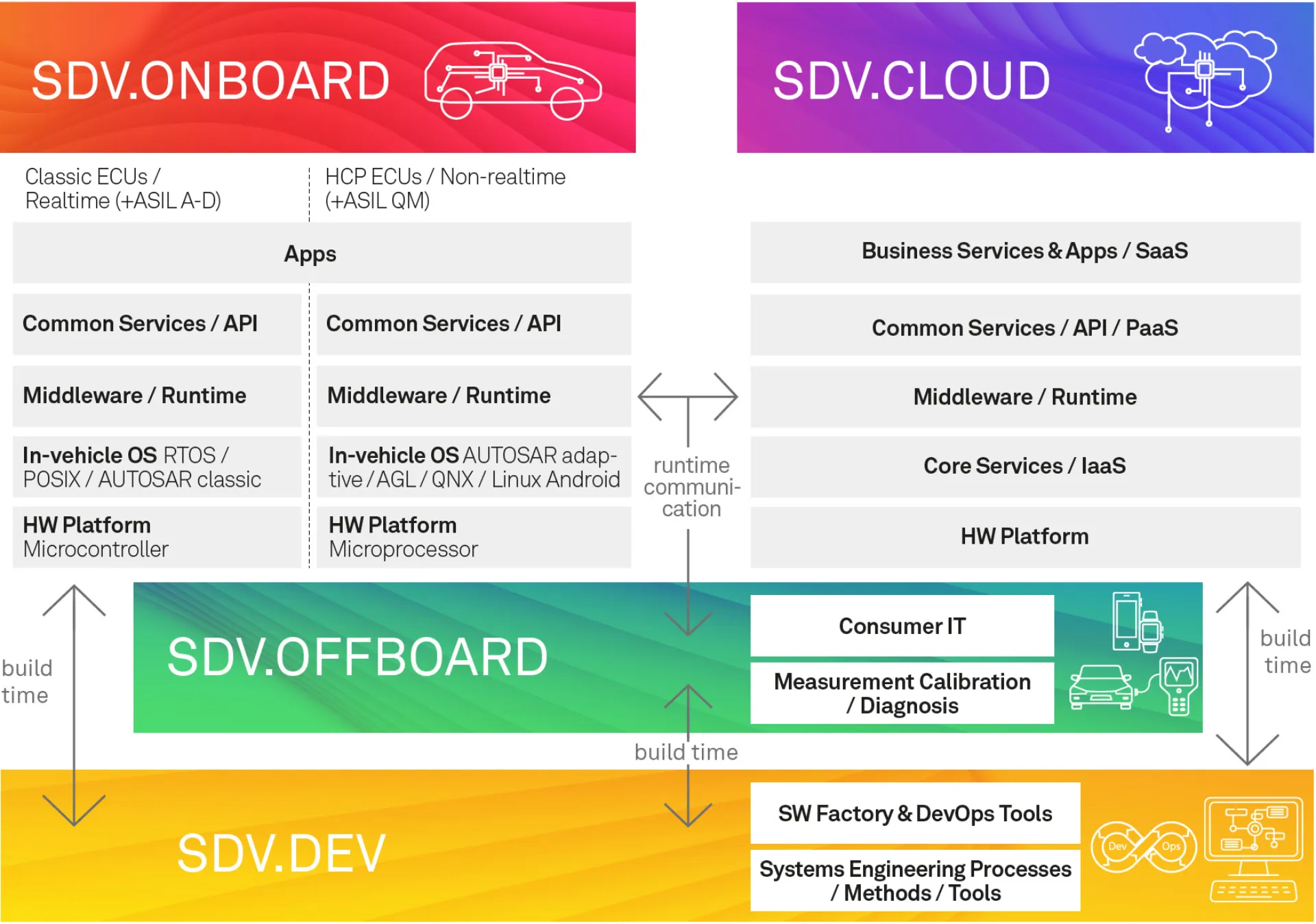
Abbildung: SDV Visualisierung
New business models thanks to vehicle data - SDV.OFFBOARD makes it possible
In a commercial context, SDV.OFFBOARD enables new data-driven business models. For example, insurance companies can analyse driving behaviour or vehicle usage in order to offer dynamic tariffs based on the ‘pay-as-you-drive’ principle. By analysing aggregated vehicle data (such as routes, usage patterns or charging behaviour), OEMs are given the opportunity to make targeted recommendations - for example on charging stations, maintenance appointments or suitable offers. By integrating smartphones or smartwatches in the car, applications can be created that offer sports drivers data-based feedback and training functions, for example.
In the non-commercial sector, SDV.OFFBOARD can play a central role in vehicle diagnostics and fleet analyses. By collecting and analysing data across entire vehicle fleets, patterns can be identified that indicate possible repair requirements or failure risks. Machine learning methods can be used to identify complex correlations between different operating parameters. For example, it is possible to analyse which combinations of temperature, vibration and state of charge typically precede a certain diagnostic ID (DID) - a key component for predictive maintenance and data-based fault prevention.
Platform potential and regulatory hurdles
In addition, the large-scale analysis of vehicle data allows valuable conclusions to be drawn about the condition of public infrastructure. Camera data in particular plays an important role here, as it provides visual indications of road damage, potholes, water accumulation or other impairments. In combination with other sensor information, a detailed picture of the road conditions is created. This information can be used specifically for winter road maintenance - for example to detect slippery conditions or amounts of snow - as well as to improve roadworks management by automatically recognising and reporting new or changed traffic routes.
Ultimately, the software-defined vehicle can be a genuine platform on which various services - including those provided by third parties - can be offered. To make this possible, edge computing nodes in the vehicle, scalable analysis backends (e.g. based on Jupyter), crowd data collectors for fleet data collection and the Extended Vehicle API (ISO 20077-80) with the Vehicle Signal Specification (W3C/COVESA) for standardised, web-based data exchange are required.
However, there is still a long way to go: in addition to the technical challenges of creating a platform that is both open enough for third parties and closed enough to be securely controlled, the vehicle business model also needs to be rethought. In addition to the necessary technical and economic changes, SDV.OFFBOARD also brings with it complex regulatory challenges. The General Data Protection Regulation (GDPR) places high demands on the collection, processing and storage of personal data - especially in the case of location-based information or driver-related behaviour. The upcoming EU Data Act will also give users the right to access the data generated by their vehicle and to decide how it is used - which calls into question the OEMs' previous data monopolies.
The EU's AI Act itself also becomes relevant, especially when AI-based processes are used for maintenance prediction or driving behaviour analysis. Transparency, traceability and fairness of the systems must be guaranteed.
We support our customers in unlocking the full potential of vehicle data and implementing AI-based solutions for highly automated driving functions and other data-driven use cases. With our expertise in ISMS consulting (ISO 27001), we help companies to optimise their information security strategies. We also offer UX/UI design for mobile applications to create seamless and intuitive user experiences.
Furthermore, we develop solutions for the Measurement / Calibration / Diagnosis (MCD) of vehicles to ensure comprehensive verification and validation. Our services include the commissioning and maintenance of HW/SW components, comprehensive system integration tests as well as security analyses and penetration tests for ECUs and IoT devices.
Through our consulting and development services, we enable companies to master the challenges of digital transformation and make SDV.OFFBOARD technologies secure, efficient and market-relevant.
msg for automotive is paving the way for the next generation of vehicles - innovatively, efficiently and effectively.

Jun 20, 2025