









.jpg)


Data ecosystems for the development of automated driving functions
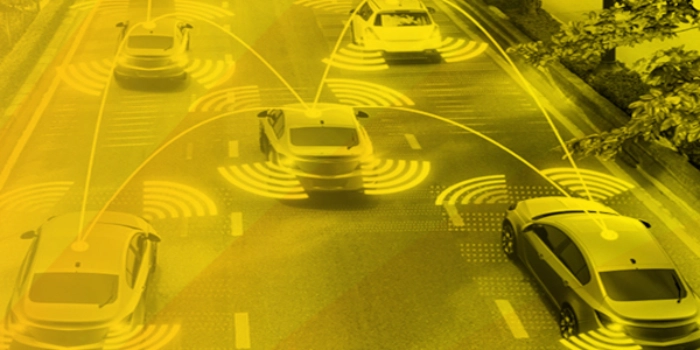
The development of automated driving functions, such as a lane departure warning system, is complex. Automobile manufacturers work closely with suppliers that develop and manufacture the sensors required for this. These sensors must then be integrated in the vehicle's complex overall system.
Similar to how the smartphone has driven the architecture of the mobile phone, the software defined vehicle (SDV) has revolutionized the traditional architecture of the vehicle. As software-centric machines, SVDs enable the data from a wide range of components to be used in new applications, allowing the vehicle to be enhanced dynamically. This means, for example, that new driving functions can be installed retroactively without having to replace the vehicle.
Digital copies of real sensors are often used in research and product development to virtually simulate the real behavior of a sensor in a computer environment. With the help of these test systems, new developments can be quickly integrated into complex units in advance – without having to use sensor prototypes or real vehicles. The virtual systems are developed in collaboration between automobile manufacturers and suppliers, which requires digital networking for data exchange and cooperation.
Do you have questions?

Dr. Markus Ketterl
Principal Business Consultant
Digital models of vehicles or sensors, training and/or test data, such as high-precision 3D maps of a section of a highway, are expensive to develop. Some files sensitive contain contents such as new functions or blueprints. Protection and control of the use of shared data are important factors for collaboration, but complex processes, transfer methods or negotiations can block developers and researchers from accessing the data they need.
In an organized data ecosystem of different parties – e.g., sensor manufacturers, OEMs, simulation developers – the collaboration models required for data use, system architectures and governance rules can be defined and implemented.
Solution modules of the developed data ecosystem
A data ecosystem is characterized by the cooperation of different players and their competences in an organizational, technical network designed for this purpose. The objective is often to develop new service offerings for customer groups through jointly usable data and services.
msg develops reference architectures for the development of data ecosystems and supports technical implementations in initiatives and networks such as the International Data Spaces Association (IDSA) and Gaia-X. Based on our experience, the requirements for data ecosystems differ greatly depending on the industry or domain (automotive, energy, health etc.).
ID determination and verification
Self-sovereign identities SSI for short): Verifiable digital identity data can be used in the data ecosystem by using digital wallets and decentralized identifier documents (DID). These solution modules can be used, for example, to resolve company affiliations of individuals or uniquely assign and verify sensor data.
Combining different data sources
The role of meta data and its use through unique semantics is also key. Jointly usable federated catalogs enable participants to provide offerings (for example 3D data for simulations, data bundles, services/tools) with associated usage/access policies. Specifically developed search mechanisms enable complex queries to the data ecosystem, for example to find suitable offerings for simulation development.
Protection of data / algorithms
The use of data is often subject to a conditional right of use, which binds the use to a purpose, a period or even the number of accesses. Compute-to-data/data-to-compute architectures are currently being used to test how requirements for a high level of individual data protection, infrastructure transparency and data sovereignty can be implemented using today's cloud technologies.
Your experts at msg
Together with 20 partners, we at msg are implementing and validating the use of data ecosystems for the development of automated driving functions and digital twins as part of a research project (Gaia-X 4 Future Mobility) and in collaboration with different research institutes (Fraunhofer, DLR, SETLabs), universities (TU Berlin, TU München), OEM (BMW), suppliers (Continental, Infineon), data specialists (3D-Mapping Solutions, TrianGraphics), test/tooling experts (Tracetronic, IQZ) and know-how carriers from Automotive Simulation (ASCS). The technical demonstrators developed and the domain knowledge serve as implementation modules for us to be able to implement further customer requirements, also in other industries, quickly and in a targeted manner.
Do you have any questions about software-defined vehicles and data-based ecosystems?
Then arrange a free virtual initial consultation today.